Latency to persistent sleep


Latency to persistent sleep8-10
Time from bedtime/ lights out until onset of sleep

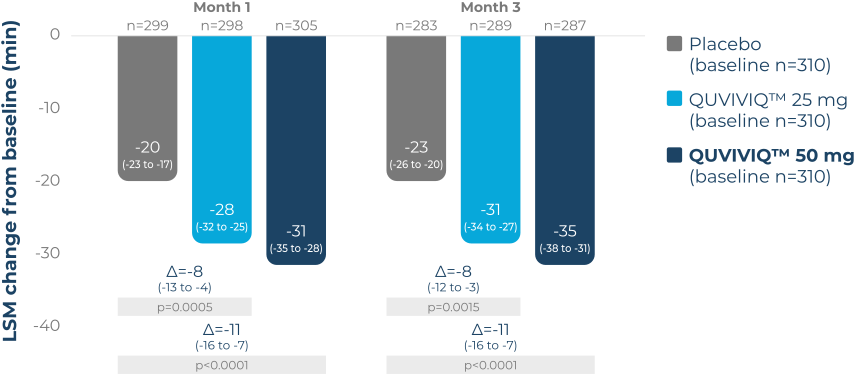
- Mean latency to persistent sleep (LPS) was over 1 hour at baseline in both Study 1 and Study 23
With QUVIVIQ™ 50 mg, patients fell asleep significantly faster versus placebo (p<0.0001)3
LPS values reported in the trials are the mean of the polysomnography recordings from two consecutive nights during the 3‑month double‑blind treatment period.3
Objective change from baseline in LPS to Months 1 and 3 for QUVIVIQ™ versus placebo (primary endpoint)3,7
Adapted from QUVIVIQ™ SPC7 and Mignot E et al, 20223
p values are versus placebo.3 All values have been presented as LSM (95% CI), as per the SPC.7
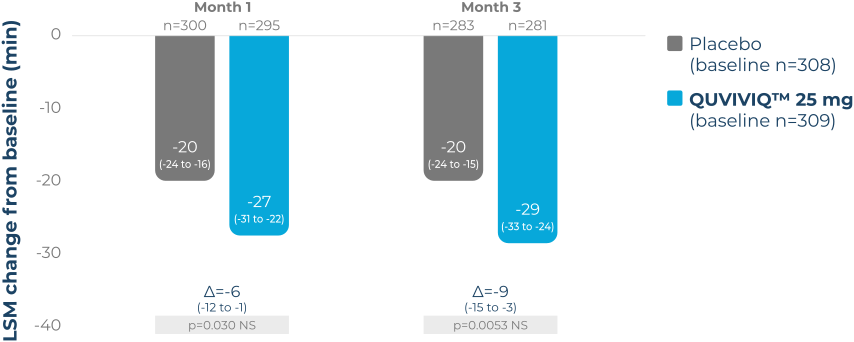
Objective change from baseline in LPS to Months 1 and 3 for QUVIVIQ™ versus placebo (primary endpoint)3,7
Adapted from QUVIVIQ™ SPC7 and Mignot E et al, 20223
p values are versus placebo.3 All values have been presented as LSM (95% CI), as per the SPC.7
Quiz Summary
0 of 1 Questions completed
Questions:
Information
You have already completed the quiz before. Hence you can not start it again.
Quiz is loading…
You must sign in or sign up to start the quiz.
You must first complete the following:
Results
Results
Time has elapsed
Categories
- Not categorized 0%
- Review
- Answered
- Correct
- Incorrect
-
Question 1 of 1
1. Question
CorrectIncorrect
Ready for the next step?
Continue to the next topic to find out more about wake time after sleep onset
CI: confidence interval; LPS: latency to persistent sleep; LSM: least squares mean; NS: not statistically significant; SPC: Summary of Product Characteristics
QUVIVIQ™ is indicated for the treatment of adult patients with insomnia characterised by symptoms present for at least 3 months and considerable impact on daytime functioning.7
This information is intended for UK healthcare professionals.
Adverse events must be reported. Healthcare professionals are asked to report any suspected adverse reactions via www.mhra.gov.uk/yellowcard or search for MHRA Yellow Card in Google Play or Apple App Store. Adverse events should also be reported to ds.safety.uk@idorsia.com
References
- Ellis J, Ferini-Strambi L et al. Chronic insomnia disorder across europe: Expert opinion on challenges and opportunities to improve care. Healthcare (Basel) 2023;11(5)
- Hafner M, Romanelli R J et al. The societal and economic burden of insomnia in adults: an international study. RAND Corporation, 2023
- Mignot E, Mayleben D et al. Safety and efficacy of daridorexant in patients with insomnia disorder: results from two multicentre, randomised, double‑blind, placebo‑controlled, phase 3 trials. Lancet Neurol 2022;21(2):125‑139
- Campbell R, Chabot I et al. Understanding the unmet needs in insomnia treatment: a systematic literature review of real‑world evidence. Int J Neurosci 2023;133(8):864‑878
- National Institute for Health and Care Excellence (NICE). Technology appraisal guidance 922. Daridorexant for treating long‑term insomnia, 18 October 2023. Available at: nice.org.uk. Accessed August 2025
- Mignot E, Mayleben D et al. Safety and efficacy of daridorexant in patients with insomnia disorder: results from two multicentre, randomised, double‑blind, placebo‑controlled, phase 3 trials. Lancet Neurol 2022;21(2):125‑139 (suppl)
- QUVIVIQ™ Idorsia Pharmaceuticals Ltd, Summary of Product Characteristics
- Sleep Foundation. Sleep latency. Available at: sleepfoundation.org. Accessed August 2025
- Morin C M, Drake C L et al. Insomnia disorder. Nat Rev Dis Primers 2015;1:15026
- Thomas D, Anderson W M. Multiple Sleep Latency Test (MSLT). Encyclopedia of sleep. Elsevier, 2013:96-99
- Sleep Foundation. Wakefulness after sleep onset. Available at: sleepfoundation.org. Accessed August 2025
- Zhu G, Catt M et al. Objective sleep assessment in >80,000 UK mid‑life adults: associations with sociodemographic characteristics, physical activity and caffeine. PLoS One 2019;14(12):e0226220
© NICE 2023 Daridorexant for treating long-term insomnia. Available from www.nice.org.uk/guidance/ta922. All rights reserved. Subject to Notice of rights.
NICE guidance is prepared for the National Health Service in England. All NICE guidance is subject to regular review and may be updated or withdrawn. NICE accepts no responsibility for the use of its content in this product/ publication.
UK-DA-00655 | Date of preparation: September 2025