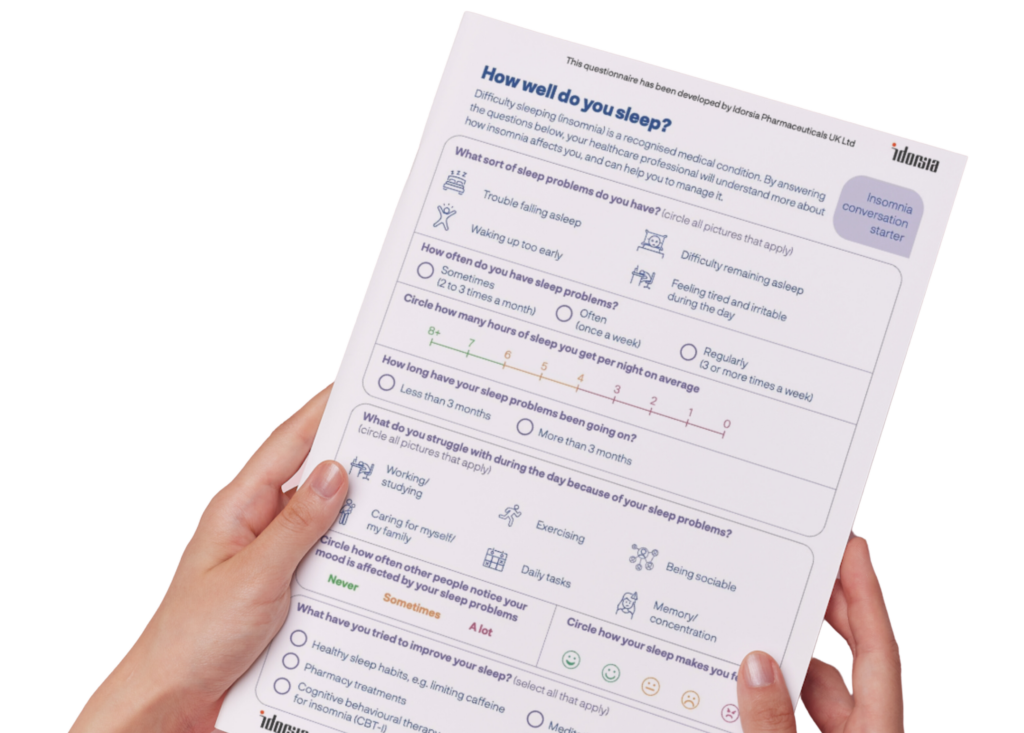
Barriers to cognitive behavioural therapy for insomnia (CBTi)


Barriers to cognitive behavioural therapy for insomnia (CBTi)
Barriers to embedding CBTi in primary care are three‑fold:6
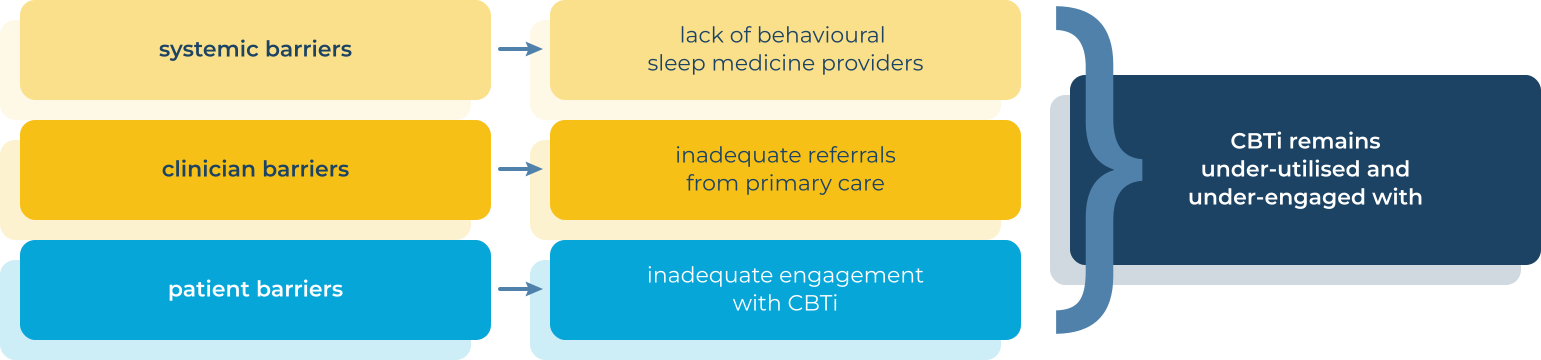
Click on the different items below to find out more
Treatment priorities6
- Insomnia has traditionally often been perceived as a symptom and not as a condition in its own right; treatment of comorbidities may be prioritised over management of insomnia
- This may be driven by a lack of understanding of the causes of insomnia and risk of chronification
GPs’ perception of the patient6
- Qualitative studies have shown that, despite belief that CBTi would be of benefit, GPs presume the patient's reluctance to engage6
- A UK study found 39% of GPs opted for pharmacological management of insomnia due to patient demand6
Lack of confidence or experience7
- GPs may have little or no personal experience of patients benefitting from CBTi, resulting in a reluctance to refer7
Lack of time or resources6
- Time constraints mean GPs may not proactively screen for insomnia, believing patients will raise the issue themselves6
- Only 20%-40% of GPs in England and Wales are able to prescribe CBTi in the UK due to limited availability and funding8
Click on the different items below to find out more
Lack of knowledge or awareness6
- Patients may lack knowledge or awareness about non-pharmacological treatment options and their effectiveness6
- 52% of participants in a UK survey did not seek treatment for their insomnia as they thought sleeping pills were their only treatment option6
- 57% do not seek medical advice because they perceive insomnia to be trivial or something they should be able to cope with alone6
Time constraints6
- Over a third of patients report that time constraints are a significant barrier to engaging with CBTi6
- Standard CBTi delivered over 4‑6 weeks, weekly or bi‑weekly, may not be feasible for many, particularly if having to organise child or elderly care6
- Use of self-led digital CBTi programmes could help circumvent these problems9
- CBTi techniques need to be adhered to for a significant period of time after the end of the CBTi sessions
Unable to fully engage6
- Changing sleep habits and schedules is challenging and requires a lot of effort and self‑discipline to fully commit6
- Many patients have tried several behavioural strategies already and are now expecting medication10
- Up to 40% of patients prematurely drop out of CBTi in clinical practice and only 47%-52% consistently adhere to recommendations6
Waiting times and accessibility6
- Due to lack of resource, access to treatment entails long waiting times6
- Long travel distances act as a deterrent to engaging with face‑to‑face CBTi6
- Use of self-led digital CBTi or therapist led online CBTi programmes could help circumvent these issues9
Pharmacological treatment
If CBTi is not sufficiently effective, unavailable or inappropriate for your patient, it is recommended that patients and their treating physicians should come to a shared decision about whether or not medication should be initiated.5 Many patients with chronic insomnia may feel like they have already exhausted options for behavioural modification, whether or not formal CBTi has been undertaken, and thus would prefer medical prescription at this stage.10
Traditional hypnotics, such as benzodiazepines and Z‑drugs are effective for the short‑term treatment of insomnia (3-7 days), however are not recommended for the long‑term management of chronic insomnia due to side effects with prolonged use.2,5,11,12
Prolonged-release melatonin is indicated as monotherapy for those ≥55 years with persistent insomnia.13 The recommended initial duration of treatment is 3 weeks and if the patient responds well, to continue for a further 10 weeks only. The risks associated with melatonin treatment in the elderly (including falls and fractures) must be assessed and discussed with the patient.2

DORAs
QUVIVIQ™ is NICE-recommended for treating insomnia in adults with symptoms lasting for 3 nights or more per week for at least 3 months, and whose daytime functioning is considerably affected, only if:14
- Cognitive Behavioural Therapy for insomnia (CBTi) has been tried but not worked, or
- CBTi is not available or is unsuitable
The length of treatment should be as short as possible. Treatment with daridorexant (QUVIVIQ™) should be assessed within 3 months of starting and should be stopped in people whose long-term insomnia has not responded adequately. If treatment is continued, assess whether it is still working at regular intervals.14
Ready for the next step?
Who to prescribe QUVIVIQ™ for and how to prescribe it
DORA: dual orexin receptor antagonist; Z-drugs: zopiclone and zolpidem
QUVIVIQ™ is indicated for the treatment of adult patients with insomnia characterised by symptoms present for at least 3 months and considerable impact on daytime functioning.15
This information is intended for UK healthcare professionals.
Adverse events must be reported. Healthcare professionals are asked to report any suspected adverse reactions via www.mhra.gov.uk/yellowcard or search for MHRA Yellow Card in Google Play or Apple App Store. Adverse events should also be reported to ds.safety.uk@idorsia.com
References
- Morin C M, Drake C L et al. Insomnia disorder. Nat Rev Dis Primers 2015;1:15026
- National Institute for Health and Care Excellence (NICE). Clinical knowledge summary. Insomnia. Scenario: managing long-term insomnia (more than 3 months duration), May 2025. Available at: cks.nice.org.uk. Accessed August 2025
- Walker J, Muench A et al. Cognitive behavioral therapy for insomnia (CBT-I): a primer. Klin Spec Psihol 2022;11(2):123-137
- Rossman J. Cognitive-behavioral therapy for insomnia: an effective and underutilized treatment for insomnia. Am J Lifestyle Med 2019;13(6):544-547
- Riemann D, Espie C A et al. The European Insomnia Guideline: an update on the diagnosis and treatment of insomnia 2023. J Sleep Res 2023;32(6):e14035
- Koffel E, Bramoweth A D, Ulmer C S. Increasing access to and utilization of cognitive behavioral therapy for insomnia (CBT-I): a narrative review. J Gen Intern Med 2018;33(6):955-962
- Davy Z, Middlemass J, Siriwardena A N. Patients’ and clinicians’ experiences and perceptions of the primary care management of insomnia: qualitative study. Health Expect 2015;18(5):1371-1383
- M3 Idorsia insomnia market research. May 2022 GP Omnibus results (N=1, 002 UK GPs; update 22 June 2022)
- Espie C A, Henry A L. Disseminating cognitive behavioural therapy (CBT) for insomnia at scale: capitalising on the potential of digital CBT to deliver clinical guideline care. J Sleep Res 2023;32(6):e14025
- O’Regan D, Garcia-Borreguero D et al. Mapping the insomnia patient journey in Europe and Canada. Front Public Health 2023;11:1233201
- Mignot E, Mayleben D et al. Safety and efficacy of daridorexant in patients with insomnia disorder: results from two multicentre, randomised, double-blind, placebo-controlled, phase 3 trials. Lancet Neurol 2022;21(2):125-139
- National Institute for Health and Care Excellence (NICE). Clinical knowledge summary. Insomnia. Scenario: managing short-term insomnia (less than 3 months duration), May 2025. Available at: cks.nice.org.uk. Accessed August 2025
- Prolonged-release melatonin Summary of Product Characteristics
- National Institute for Health and Care Excellence (NICE). Technology appraisal guidance 922. Daridorexant for treating long‑term insomnia, 18 October 2023. Available at: nice.org.uk. Accessed August 2025
- QUVIVIQ™ Idorsia Pharmaceuticals Ltd, Summary of Product Characteristics
© NICE 2023 Daridorexant for treating long-term insomnia. Available from www.nice.org.uk/guidance/ta922. All rights reserved. Subject to Notice of rights.
NICE guidance is prepared for the National Health Service in England. All NICE guidance is subject to regular review and may be updated or withdrawn. NICE accepts no responsibility for the use of its content in this product/ publication.
UK-DA-00656 | Date of preparation: September 2025