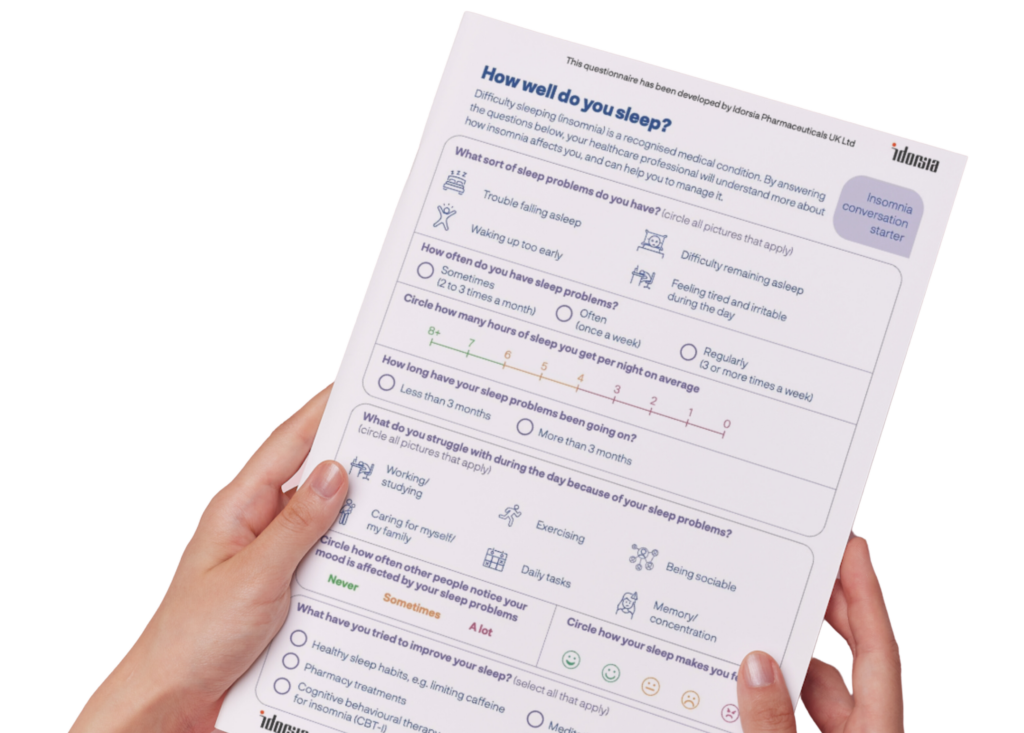
Risk factors for insomnia


Risk factors for insomnia
- predisposing factors that encompass psychological and physiological characteristics
- precipitating factors such as stressful events that trigger an acute episode of insomnia
- perpetuating factors such as behavioural strategies developed to cope with an episode of acute insomnia that conversely result in the maintenance of insomnia

Older age (>60 years)
Aging is associated with changes in sleep patterns:16
- less time in deep (slow wave) sleep
- more frequent and prolonged nocturnal awakenings and time spent awake during the night






Regular exercise is linked to better sleep quality, regardless of the mode and intensity of the activity, particularly in older patients or patients with a comorbidity.9

Nicotine is a stimulant of the heart and CNS and disrupts circadian rhythms. Smokers often experience shorter and lower-quality sleep compared with non-smoking counterparts.21
Despite being a somnogen, alcohol causes frequent night-time and early morning awakenings, difficulty maintaining sleep and short sleep duration.13

Diet
Diets high in fat but low in carbohydrates and protein have been linked to difficulties with maintaining sleep. Malted milk, fatty fish, cherries and kiwifruit may help to promote high‑quality sleep.8

Consumption of caffeine (particularly in coffee and energy drinks) is associated with significant sleep disturbances.22 Appropriate sleep hygiene advice would be to refrain from substantial caffeine after 2 pm.
Irregular sleep schedules, inconsistent bedtime routines and excessive use of electronic devices prior to sleep may contribute to poor sleep.23,24

The retina connects light with the internal circadian rhythm; exposure to natural daylight is beneficial to sleep quality.25
Ready for the next step?
The direct impact of chronic insomnia on patients
CNS: central nervous system; COPD: chronic obstructive pulmonary disease; SSRIs: selective serotonin reuptake inhibitors
QUVIVIQ™ is indicated for the treatment of adult patients with insomnia characterised by symptoms present for at least 3 months and considerable impact on daytime functioning.34
This information is intended for UK healthcare professionals.
Adverse events must be reported. Healthcare professionals are asked to report any suspected adverse reactions via www.mhra.gov.uk/yellowcard or search for MHRA Yellow Card in Google Play or Apple App Store. Adverse events should also be reported to ds.safety.uk@idorsia.com
References
- World Health Organization (WHO). International statistical classification of diseases and related health problems (ICD) 11th revision. Available at: icd.who.int. Accessed August 2025
- Hafner M, Romanelli R J et al. The societal and economic burden of insomnia in adults: an international study. RAND Corporation, 2023
- Morin C M, Jarrin D C et al. Incidence, persistence, and remission rates of insomnia over 5 years. JAMA Netw Open 2020;3(11):e2018782
- Johnson E O, Roth T et al. Epidemiology of DSM-IV insomnia in adolescence: lifetime prevalence, chronicity, and an emergent gender difference. Pediatrics 2006;117(2):e247-256
- Bhaskar S, Hemavathy D, Prasad S. Prevalence of chronic insomnia in adult patients and its correlation with medical comorbidities. J Family Med Prim Care 2016;5(4):780‑784
- Klink M E, Quan S F et al. Risk factors associated with complaints of insomnia in a general adult population. Influence of previous complaints of insomnia. Arch Intern Med 1992;152(8):1634‑1637
- Torrens Darder I, Argüelles‑Vázquez R et al. Primary care is the frontline for help‑seeking insomnia patients. Eur J Gen Pract 2021;27(1):286‑293
- St‑Onge M P, Mikic A, Pietrolungo C E. Effects of diet on sleep quality. Adv Nutr 2016;7(5):938‑949
- Dolezal B A, Neufeld E V et al. Interrelationship between sleep and exercise: a systematic review. Adv Prev Med 2017;2017:1364387
- Burns A C, Saxena R et al. Time spent in outdoor light is associated with mood, sleep, and circadian rhythm-related outcomes: a cross-sectional and longitudinal study in over 400,000 UK Biobank participants. J Affect Disord 2021;295:347-352
- Nowakowski S, Meers J, Heimbach E. Sleep and women’s health. Sleep Med Res 2013;4(1):1‑22
- Neubauer D N. Sleep problems in the elderly. Am Fam Physician 1999;59(9):2551‑2558, 2559‑2560
- Park S Y, Oh M K et al. The effects of alcohol on quality of sleep. Korean J Fam Med 2015;36(6):294‑299
- Riemann D, Baglioni C et al. European guideline for the diagnosis and treatment of insomnia. J Sleep Res 2017;26(6):675‑700
- Morin C M, Drake C L et al. Insomnia disorder. Nat Rev Dis Primers 2015;1:15026
- Li J, Vitiello M V, Gooneratne N S. Sleep in normal aging. Sleep Med Clin 2018;13(1):1‑11
- Ferri P, Guadi M et al. The impact of shift work on the psychological and physical health of nurses in a general hospital: a comparison between rotating night shifts and day shifts. Risk Manag Healthc Policy 2016;9:203‑211
- Oh C M, Kim H Y et al. The effect of anxiety and depression on sleep quality of individuals with high risk for insomnia: a population‑based study. Front Neurol 2019;10:849
- Ezzie M E, Parsons J P, Mastronarde J G. Sleep and obstructive lung diseases. Sleep Med Clin 2008;3(4):505‑515
- Lim D C, Najafi A et al. The need to promote sleep health in public health agendas across the globe. Lancet Public Health 2023;8(10):e820‑e826
- Singh N, Wanjari A, Sinha A. Effects of nicotine on the central nervous system and sleep quality in relation to other stimulants: a narrative review. Cureus 2023;15(11):e49162
- Drake C, Roehrs T et al. Caffeine effects on sleep taken 0, 3, or 6 hours before going to bed. J Clin Sleep Med 2013;9(11):1195‑1200
- National Institute for Health and Care Excellence (NICE). Clinical knowledge summary. Insomnia. Scenario: managing short-term insomnia (less than 3 months duration), May 2025. Available at: cks.nice.org.uk. Accessed August 2025
- Kang J, Chen S. Effects of an irregular bedtime schedule on sleep quality, daytime sleepiness, and fatigue among university students in Taiwan. BMC Public Health 2009;9:248
- Blume C, Garbazza C, Spitschan M. Effects of light on human circadian rhythms, sleep and mood. Somnologie (Berl) 2019;23(3):147‑156
- National Institute for Health and Care Excellence (NICE). Clinical knowledge summary. Insomnia, May 2025. Available at: cks.nice.org.uk. Accessed August 2025
- Babson K A, Trainor C D et al. A test of the effects of acute sleep deprivation on general and specific self‑reported anxiety and depressive symptoms: an experimental extension. J Behav Ther Exp Psychiatry 2010;41(3):297‑303
- Minkel J D, Banks S et al. Sleep deprivation and stressors: evidence for elevated negative affect in response to mild stressors when sleep deprived. Emotion 2012;12(5):1015‑1020
- Dinges D F, Pack F et al. Cumulative sleepiness, mood disturbance, and psychomotor vigilance performance decrements during a week of sleep restricted to 4‑5 hours per night. Sleep 1997;20(4):267‑277
- Astill R G, Van der Heijden K B et al. Sleep, cognition, and behavioral problems in school‑age children: a century of research meta‑analyzed. Psychol Bull 2012;138(6):1109‑1138
- Chen T Y, Lee S, Buxton O M. A greater extent of insomnia symptoms and physician‑recommended sleep medication use predict fall risk in community‑dwelling older adults. Sleep 2017;40(11): doi:10.1093/sleep/zsx142
- Centers for Disease Control and Prevention (CDC). Facts about falls, May 2023. Available at: cdc.gov. Accessed August 2025
- Léger D, Bayon V et al. Insomnia and accidents: cross-sectional study (EQUINOX) on sleep-related home, work and car accidents in 5293 subjects with insomnia from 10 countries. J Sleep Res 2014;23(2):143‑152
- QUVIVIQ™ Idorsia Pharmaceuticals Ltd, Summary of Product Characteristics
© NICE 2023 Daridorexant for treating long-term insomnia. Available from www.nice.org.uk/guidance/ta922. All rights reserved. Subject to Notice of rights.
NICE guidance is prepared for the National Health Service in England. All NICE guidance is subject to regular review and may be updated or withdrawn. NICE accepts no responsibility for the use of its content in this product/ publication.
UK-DA-00658 | Date of preparation: September 2025