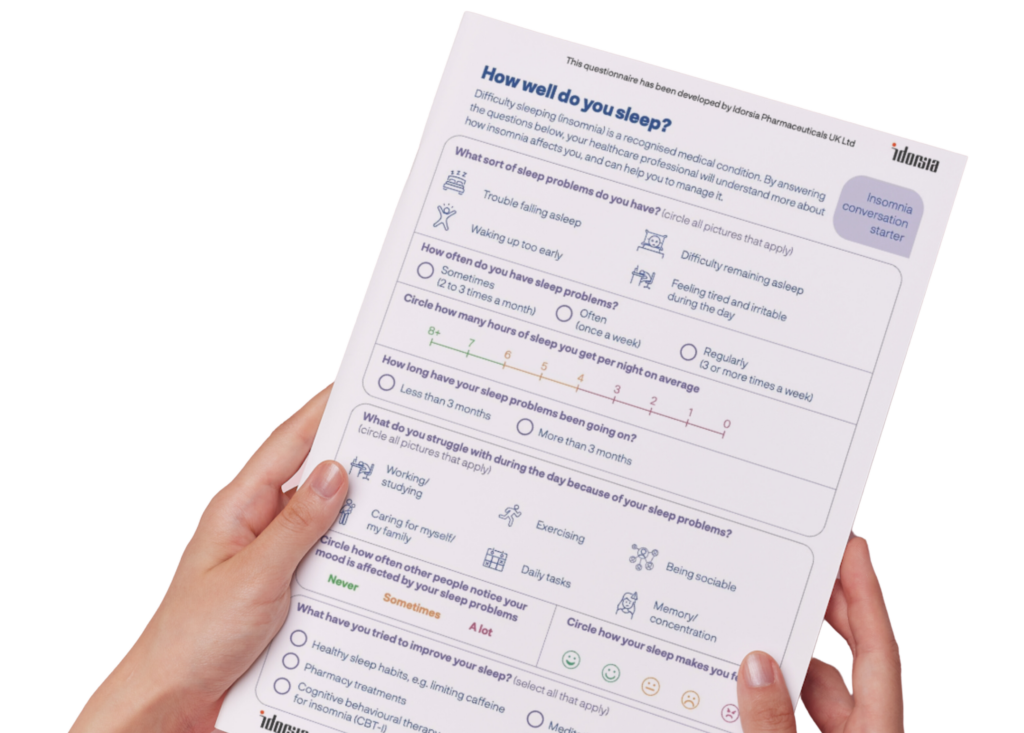
The indirect impact of chronic insomnia on patients

Apart from the direct impact chronic insomnia has on patients, its effects are widespread.1
There is a complex, bidirectional and not fully elucidated association between insomnia and other medical and psychiatric disorders.2 Studies have shown that chronic sleep loss contributes to physiological changes that accumulate over time and may result in serious health consequences, increasing the risk of:
Obesity3
Coronary heart disease4
Chronic insomnia and cardiovascular risk9
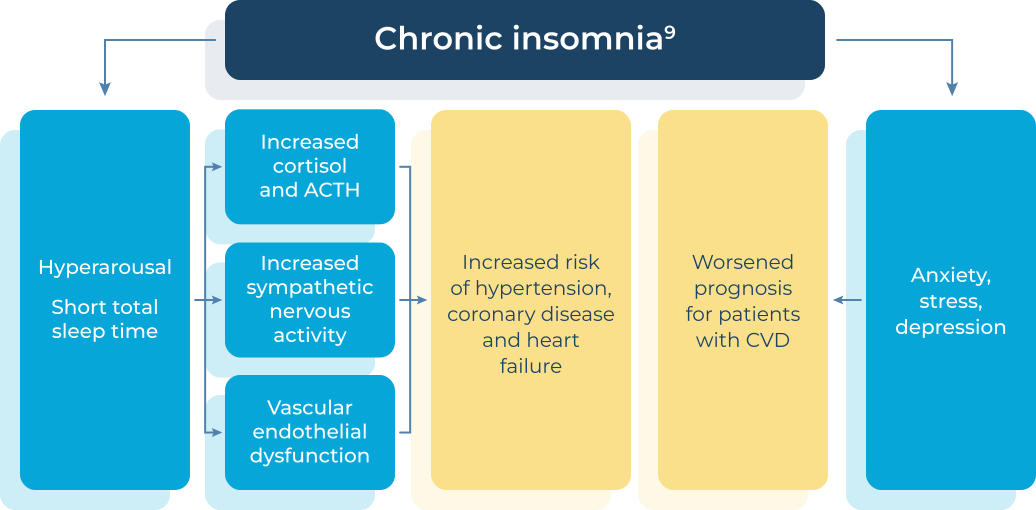
Insomnia and cardiovascular disease (CVD) are both highly prevalent, and are interlinked.9
- Patients with insomnia have a 45% higher risk of developing CVD
- Insomnia is a major predictor of poor prognosis in patients with CVD
ACTH: adrenocorticotropic hormone
Chronic insomnia and cancer risk10
Time to watch: 4 mins 33 secs
Quiz Summary
0 of 1 Questions completed
Questions:
Information
You have already completed the quiz before. Hence you can not start it again.
Quiz is loading…
You must sign in or sign up to start the quiz.
You must first complete the following:
Results
Results
Time has elapsed
Categories
- Not categorized 0%
-
Thank you for your response.
- Review
- Answered
- Correct
- Incorrect
-
Question 1 of 1
1. Question
Ready for the next step?
Other impacts of chronic insomnia
CVD: cardiovascular disease
QUVIVIQ™ is indicated for the treatment of adult patients with insomnia characterised by symptoms present for at least 3 months and considerable impact on daytime functioning.17
This information is intended for UK healthcare professionals.
Adverse events must be reported. Healthcare professionals are asked to report any suspected adverse reactions via www.mhra.gov.uk/yellowcard or search for MHRA Yellow Card in Google Play or Apple App Store. Adverse events should also be reported to ds.safety.uk@idorsia.com
References
- Hafner M, Romanelli R J et al. The societal and economic burden of insomnia in adults: an international study. RAND Corporation, 2023
- Morin C M, Drake C L et al. Insomnia disorder. Nat Rev Dis Primers 2015;1:15026
- Covassin N, Singh P, Somers V K. Keeping up with the clock: circadian disruption and obesity risk. Hypertension 2016;68(5):1081-1090
- Itani O, Jike M et al. Short sleep duration and health outcomes: a systematic review, meta-analysis, and meta-regression. Sleep Med 2017;32:246-256
- Schmitz N C M, van der Werf Y D, Lammers-van der Holst H M. The importance of sleep and circadian rhythms for vaccination success and susceptibility to viral infections. Clocks Sleep 2022;4(1):66-79
- Robbins R, Quan S F et al. Examining sleep deficiency and disturbance and their risk for incident dementia and all-cause mortality in older adults across 5 years in the United States. Aging (Albany NY) 2021;13(3):3254-3268
- Fernández-de-Las-Peñas C, Fernández-Muñoz J J et al. Sleep disturbances in tension-type headache and migraine. Ther Adv Neurol Disord 2018;11:1756285617745444
- Lim D C, Najafi A et al. The need to promote sleep health in public health agendas across the globe. Lancet Public Health 2023;8(10):e820-e826
- Andersen M L, Poyares D, Tufik S. Insomnia and cardiovascular outcomes. Sleep Sci 2021;14(1):1-2
- Shi T, Min M et al. Does insomnia predict a high risk of cancer? A systematic review and meta-analysis of cohort studies. Journal of Sleep Research 2020;29(1):e12876
- Ishak W W, Bagot K et al. Quality of life in patients suffering from insomnia. Innov Clin Neurosci 2012;9(10):13-26
- Anderson L H, Whitebird R R et al. Healthcare utilization and costs in persons with insomnia in a managed care population. Am J Manag Care 2014;20(5):e157-165
- National Institute for Health and Care Excellence (NICE). Clinical knowledge summary. Insomnia. Scenario: managing long-term insomnia (more than 3 months duration), May 2025. Available at: cks.nice.org.uk. Accessed August 2025
- Matteson-Rusby S E, Pigeon W R et al. Why treat insomnia? Prim Care Companion J Clin Psychiatry 2010;12(1):PCC.08r00743
- Wilson S, Anderson K et al. British Association for Psychopharmacology consensus statement on evidence-based treatment of insomnia, parasomnias and circadian rhythm disorders: an update. J Psychopharmacol 2019;33(8):923-947
- Clinical Practice Research Datalink. Safeguarding patient data (2023). Available at: cprd.com. Accessed August 2025
- QUVIVIQ™ Idorsia Pharmaceuticals Ltd, Summary of Product Characteristics
- National Institute for Health and Care Excellence (NICE). Technology appraisal guidance 922. Daridorexant for treating long‑term insomnia, 18 October 2023. Available at: nice.org.uk. Accessed August 2025
© NICE 2023 Daridorexant for treating long-term insomnia. Available from www.nice.org.uk/guidance/ta922. All rights reserved. Subject to Notice of rights.
NICE guidance is prepared for the National Health Service in England. All NICE guidance is subject to regular review and may be updated or withdrawn. NICE accepts no responsibility for the use of its content in this product/ publication.
UK-DA-00658 | Date of preparation: September 2025