What can be done?


What can be done?
The health benefits of good sleep and the adverse consequences of sleep deficiency are evident. Although more global data may refine the knowledge base, enough is known to be able to act now to achieve better health.8
There are three main pillars to be implemented at a local, regional and national level.1,8
Education
Click to learn more
Research
Click to learn more
Public Health Policies
Click to learn more
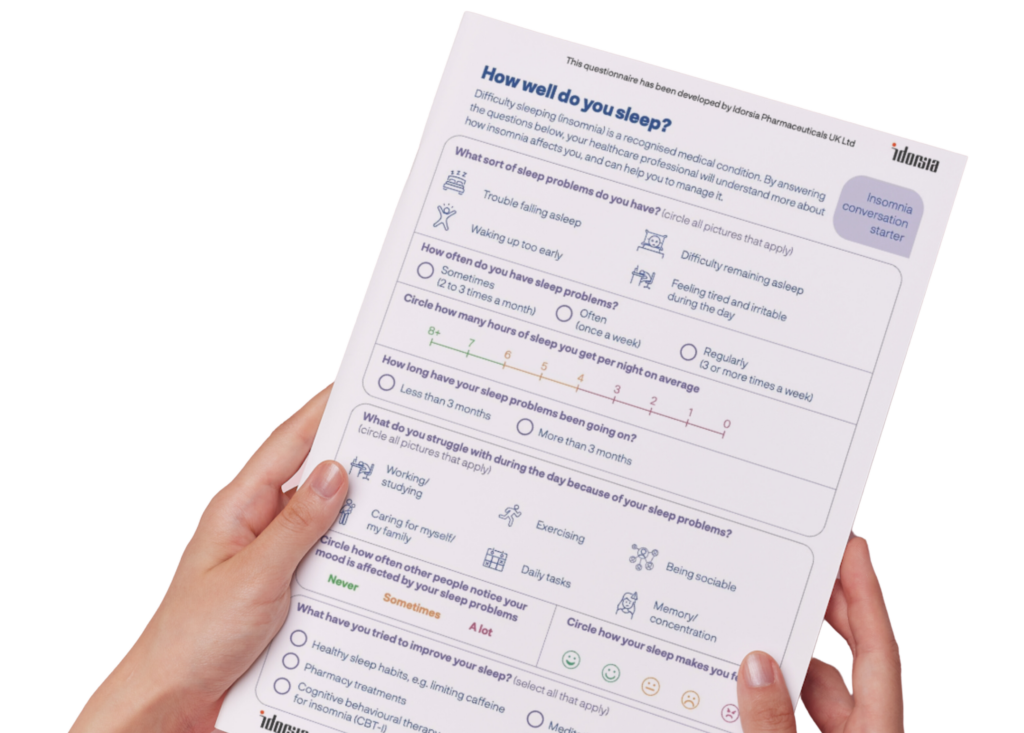
There are ways to support patients with improved sleep and treating chronic insomnia:
-
Support patients with good sleep hygiene practices such as creating a restful bedroom environment and setting a constant bed and rising time. The NHS website, Every mind matters, has tips for practising good sleep hygiene and promoting better sleep
- Consider referring eligible patients for cognitive behavioural therapy for insomnia (CBTi)
For adult patients with long-term chronic insomnia and for whom CBTi is not available, unsuitable or hasn’t worked, NICE recommends prescribing QUVIVIQ.18
Ready for the next step?
CBTi: cognitive behavioural therapy for insomnia
QUVIVIQ™ is indicated for the treatment of adult patients with insomnia characterised by symptoms present for at least 3 months and considerable impact on daytime functioning.17
This information is intended for UK healthcare professionals.
Adverse events must be reported. Healthcare professionals are asked to report any suspected adverse reactions via www.mhra.gov.uk/yellowcard or search for MHRA Yellow Card in Google Play or Apple App Store. Adverse events should also be reported to ds.safety.uk@idorsia.com
References
- Hafner M, Romanelli R J et al. The societal and economic burden of insomnia in adults: an international study. RAND Corporation, 2023
- Morin C M, Drake C L et al. Insomnia disorder. Nat Rev Dis Primers 2015;1:15026
- Covassin N, Singh P, Somers V K. Keeping up with the clock: circadian disruption and obesity risk. Hypertension 2016;68(5):1081-1090
- Itani O, Jike M et al. Short sleep duration and health outcomes: a systematic review, meta-analysis, and meta-regression. Sleep Med 2017;32:246-256
- Schmitz N C M, van der Werf Y D, Lammers-van der Holst H M. The importance of sleep and circadian rhythms for vaccination success and susceptibility to viral infections. Clocks Sleep 2022;4(1):66-79
- Robbins R, Quan S F et al. Examining sleep deficiency and disturbance and their risk for incident dementia and all-cause mortality in older adults across 5 years in the United States. Aging (Albany NY) 2021;13(3):3254-3268
- Fernández-de-Las-Peñas C, Fernández-Muñoz J J et al. Sleep disturbances in tension-type headache and migraine. Ther Adv Neurol Disord 2018;11:1756285617745444
- Lim D C, Najafi A et al. The need to promote sleep health in public health agendas across the globe. Lancet Public Health 2023;8(10):e820-e826
- Andersen M L, Poyares D, Tufik S. Insomnia and cardiovascular outcomes. Sleep Sci 2021;14(1):1-2
- Shi T, Min M et al. Does insomnia predict a high risk of cancer? A systematic review and meta-analysis of cohort studies. Journal of Sleep Research 2020;29(1):e12876
- Ishak W W, Bagot K et al. Quality of life in patients suffering from insomnia. Innov Clin Neurosci 2012;9(10):13-26
- Anderson L H, Whitebird R R et al. Healthcare utilization and costs in persons with insomnia in a managed care population. Am J Manag Care 2014;20(5):e157-165
- National Institute for Health and Care Excellence (NICE). Clinical knowledge summary. Insomnia. Scenario: managing long-term insomnia (more than 3 months duration), May 2025. Available at: cks.nice.org.uk. Accessed August 2025
- Matteson-Rusby S E, Pigeon W R et al. Why treat insomnia? Prim Care Companion J Clin Psychiatry 2010;12(1):PCC.08r00743
- Wilson S, Anderson K et al. British Association for Psychopharmacology consensus statement on evidence-based treatment of insomnia, parasomnias and circadian rhythm disorders: an update. J Psychopharmacol 2019;33(8):923-947
- Clinical Practice Research Datalink. Safeguarding patient data (2023). Available at: cprd.com. Accessed August 2025
- QUVIVIQ™ Idorsia Pharmaceuticals Ltd, Summary of Product Characteristics
- National Institute for Health and Care Excellence (NICE). Technology appraisal guidance 922. Daridorexant for treating long‑term insomnia, 18 October 2023. Available at: nice.org.uk. Accessed August 2025
© NICE 2023 Daridorexant for treating long-term insomnia. Available from www.nice.org.uk/guidance/ta922. All rights reserved. Subject to Notice of rights.
NICE guidance is prepared for the National Health Service in England. All NICE guidance is subject to regular review and may be updated or withdrawn. NICE accepts no responsibility for the use of its content in this product/ publication.
UK-DA-00658 | Date of preparation: September 2025