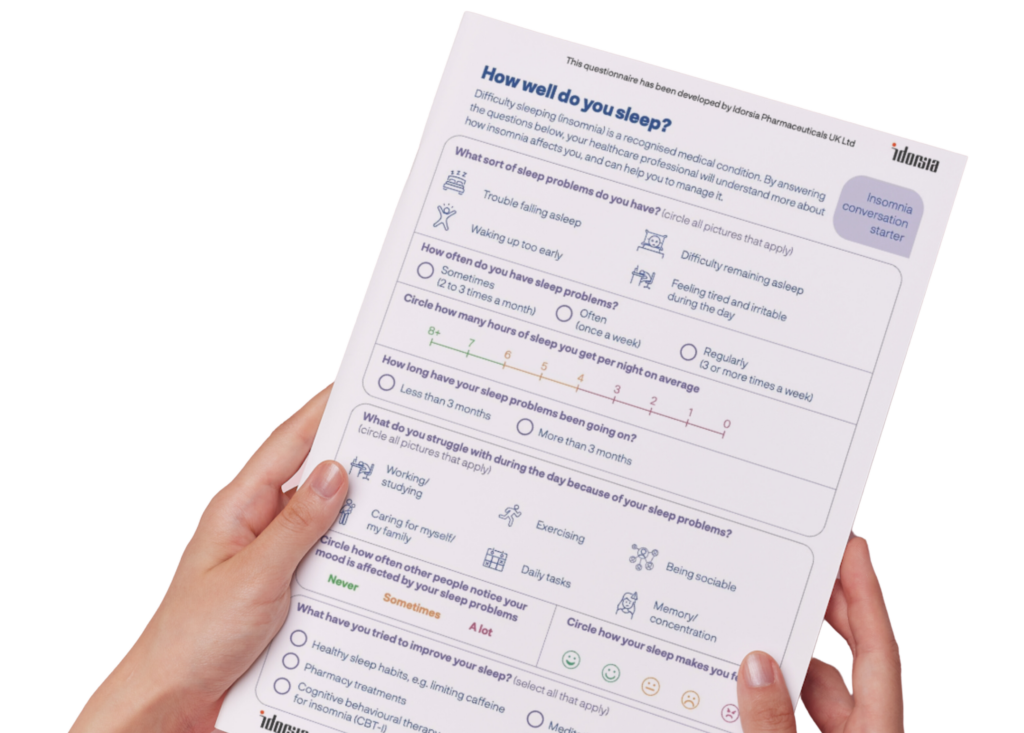
The Insomnia Daytime Symptoms and Impacts Questionnaire


The Insomnia Daytime Symptoms and Impacts Questionnaire (IDSIQ) is a patient-reported outcome (PRO) measure of daytime functioning, validated according to FDA guidelines and composed of 14 questions across three domains.3,4
It has been developed and validated for use in clinical research and is not for use in clinical practice.3
IDSIQ
Total score (0-140)3,8,9 *
Clinically meaningful change: ≥17 from baseline8
Sleepiness domain score (0‑40)3,9
- How energetic did you feel today?
- How mentally tired did you feel today?
- How physically tired did you feel today?
- How sleepy did you feel today
Clinically meaningful change: ≥4

Alert/ cognition domain score (0‑60)3,9
- How clear-headed did you feel today?
- How well were you able to concentrate today?
- How forgetful did you feel today?
- How much of an effort was it to perform daily activities today?
- How refreshed did you feel today?
- How awake did you feel today
Clinically meaningful change: ≥9

Mood domain score (0‑40)3,9
- How worried did you feel today?
- How frustrated by your lack of sleep did you feel today
- How irritable did you feel today?
- How stressed did you feel today?
Clinically meaningful change: ≥4
*Higher score indicates greater impairment.
FDA: United States Food and Drug Administration
In the QUVIVIQ™ trials, daytime functioning was assessed using IDSIQ4
- Patients completed the IDSIQ every evening at home to assess how they had felt throughout the day4
- IDSIQ scores were based on the mean of daily diary entries in the 7 days prior to polysomnography4
IDSIQ sleepiness domain
IDSIQ sleepiness domain was used as a proxy for daytime functioning.
- IDSIQ sleepiness domain score was 22-23 at baseline in both Study 1 and Study 24
Compared with placebo, 50 mg QUIVIVIQ™ demonstrated a significant decrease in mean score of ‑5.7 at Month 3; this surpasses the threshold for clinically relevant change.4,6
Objective change from baseline in daytime sleepiness at Months 1 and 3 for QUVIVIQ™ versus placebo (secondary endpoint)4,6
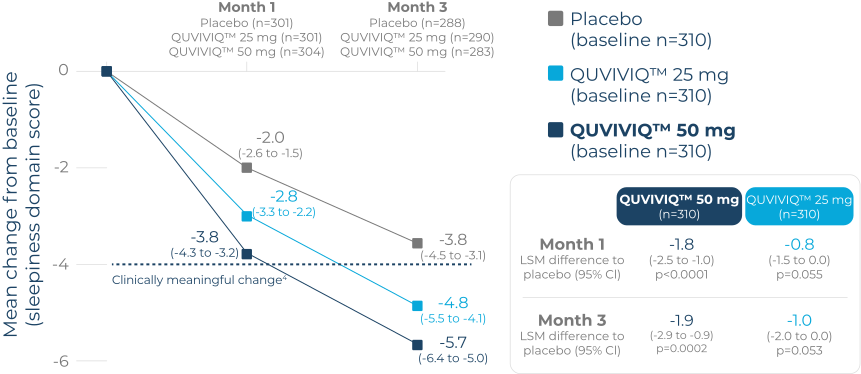
Adapted from QUVIVIQ™ SPC6 and Mignot E et al, 20224
All values have been presented as LSM (95% CI), as per the SPC.6
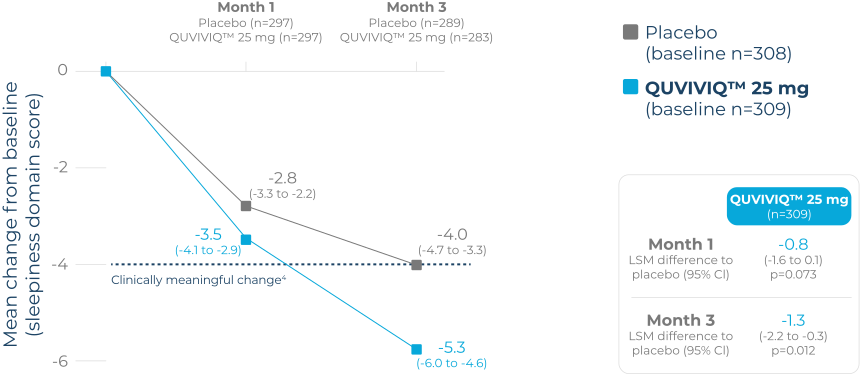
Adapted from QUVIVIQ™ SPC6 and Mignot E et al, 20224
All values have been presented as LSM (95% CI), as per the SPC.6
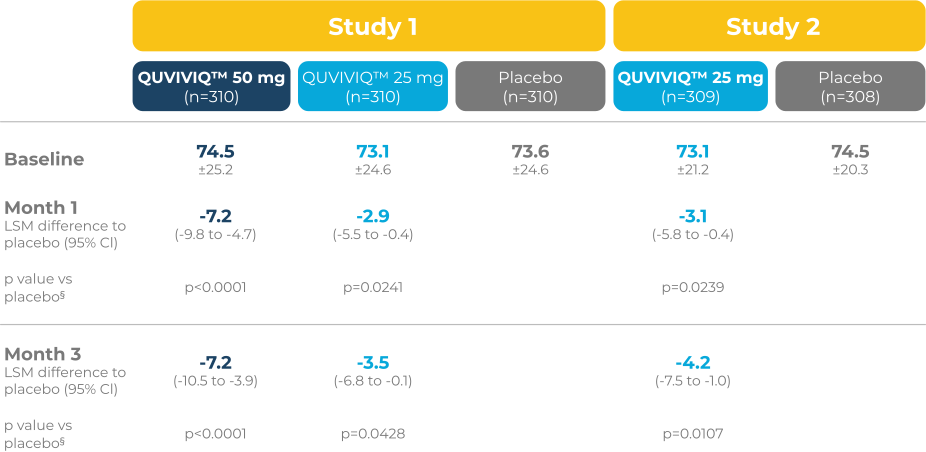
IDSIQ total score
Compared with placebo, 50 mg QUIVIVIQ™ demonstrated a significant decrease in mean score of ‑7.2 at Month 3 (p<0.0001); this does not reach the threshold for clinically relevant change.
Difference versus placebo of mean observed value of IDSIQ total scores at Months 1 and 3 for QUVIVIQ™ (prespecified efficacy endpoint)4,7
Quiz Summary
0 of 1 Questions completed
Questions:
Information
You have already completed the quiz before. Hence you can not start it again.
Quiz is loading…
You must sign in or sign up to start the quiz.
You must first complete the following:
Results
Results
Time has elapsed
Categories
- Not categorized 0%
-
Thank you for your response.
There was no evidence of abuse or withdrawal symptoms indicative of physical dependence when QUVIVIQ™ treatment was discontinued in clinical studies.6 However, because individuals with a history of abuse or addiction to alcohol or other substances may be at increased risk for abuse of QUVIVIQ™, these patients should be followed carefully.6
The safety profile of QUVIVIQ™ has been demonstrated for 12 months of continuous treatment. Note that treatment duration should be as short as possible; appropriateness of continuation should be assessed within 3 months and periodically thereafter.6
- Review
- Answered
- Correct
- Incorrect
-
Question 1 of 1
1. Question
Ready for the next step?
Continue to the next topic to find out more about the safety profile of QUVIVIQ™
IDSIQ: Insomnia Daytime Symptoms and Impacts Questionnaire; PRO: Patient-reported outcome
QUVIVIQ™ is indicated for the treatment of adult patients with insomnia characterised by symptoms present for at least 3 months and considerable impact on daytime functioning.6
This information is intended for UK healthcare professionals.
Adverse events must be reported. Healthcare professionals are asked to report any suspected adverse reactions via www.mhra.gov.uk/yellowcard or search for MHRA Yellow Card in Google Play or Apple App Store. Adverse events should also be reported to ds.safety.uk@idorsia.com
References
- Riemann D, Benz F et al. Insomnia disorder: state of the science and challenges for the future. J Sleep Res 2022;31(4):e13604
- Ellis J, Ferini‑Strambi L et al. Chronic insomnia disorder across europe: expert opinion on challenges and opportunities to improve care. Healthcare (Basel) 2023;11(5)
- Hudgens S, Phillips‑Beyer A et al. Development and validation of the insomnia daytime symptoms and impacts questionnaire (IDSIQ). Patient 2021;14(2):249‑268
- Mignot E, Mayleben D et al. Safety and efficacy of daridorexant in patients with insomnia disorder: results from two multicentre, randomised, double‑blind, placebo‑controlled, phase 3 trials. Lancet Neurol 2022;21(2):125‑139
- Luyet P, Olivieri A, Braunstein G. Understanding daytime functioning in insomnia: responder and correlation analyses in patients treated with daridorexant. Sleep Sci Pract 2023;7(7)
- QUVIVIQ™ Idorsia Pharmaceuticals Ltd, Summary of Product Characteristics
- Mignot E, Mayleben D et al. Safety and efficacy of daridorexant in patients with insomnia disorder: results from two multicentre, randomised, double‑blind, placebo‑controlled, phase 3 trials. Lancet Neurol 2022;21(2):125‑139 (suppl)
- Phillips-Beyer A, Kawata A K et al. Meaningful within-patient change on the insomnia daytime symptoms and impacts questionnaire (IDSIQ): analysis of phase III clinical trial data of daridorexant. Pharmaceut Med 2023;37:291-303
Hudgens S, Phillips-Beyer A et al. Summary of research: development and validation of the insomnia daytime symptoms and impacts questionnaire (IDSIQ). Adv Ther 2023;40:2573-2576
© NICE 2023 Daridorexant for treating long-term insomnia. Available from www.nice.org.uk/guidance/ta922. All rights reserved. Subject to Notice of rights.
NICE guidance is prepared for the National Health Service in England. All NICE guidance is subject to regular review and may be updated or withdrawn. NICE accepts no responsibility for the use of its content in this product/ publication.
UK-DA-00655 | Date of preparation: September 2025