Introducing Bunmi


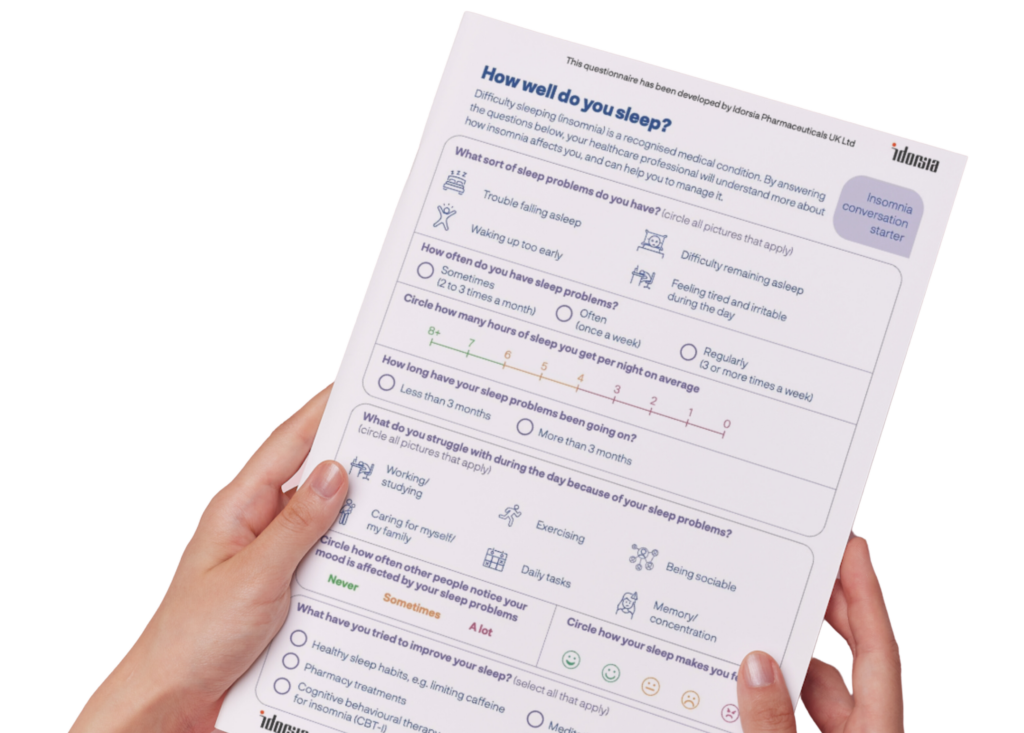
Managing chronic insomnia in a postmenopausal female
This is a fictional case study, based on a typical patient you may encounter in clinical practice.

Image is of a model
Bunmi, 53 – Care worker
Sleep history
Sleep problems started during perimenopause (4 years ago).
Worsened over last 6-12 months with total sleep time of 4‑5 hours.
She has tried guided relaxations and better sleep hygiene based on online advice.
Medical history
HRT (transdermal patches) – alleviated vasomotor menopausal symptoms but no effect on sleep.
Tried OTC herbal medications for sleep.
Otherwise generally healthy; no other medication.
Family and social history
Lives with partner and two teenage children.
Carer for elderly parent with cancer.
Current consideration
Bunmi has stopped taking on shifts as a care worker as is struggling to function during the daytime.
CBT: cognitive behavioural therapy; CBTi: cognitive behavioural therapy for insomnia; HRT: hormone replacement therapy; NICE: National Institute for Health and Care Excellence; OTC: over‑the‑counter; PRO: patient‑reported outcome
QUVIVIQ™ is indicated for the treatment of adult patients with insomnia characterised by symptoms present for at least 3 months and considerable impact on daytime functioning.21
This information is intended for UK healthcare professionals.
Adverse events must be reported. Healthcare professionals are asked to report any suspected adverse reactions via www.mhra.gov.uk/yellowcard or search for MHRA Yellow Card in Google Play or Apple App Store. Adverse events should also be reported to ds.safety.uk@idorsia.com
References
- The Epworth Sleepiness Scale. Available at: nasemso.org. Accessed August 2025
- Riemann D, Espie C A et al. The European Insomnia Guideline: an update on the diagnosis and treatment of insomnia 2023. J Sleep Res 2023;32(6):e14035
- Stern A F. The hospital anxiety and depression scale. Occup Med (Lond) 2014;64(5):393-394
- World Health Organization (WHO). International statistical classification of diseases and related health problems (ICD) 11th revision. Available at: icd.who.int. Accessed August 2025
- National Institute for Health and Care Excellence (NICE). Clinical knowledge summary. Insomnia. Scenario: managing long-term insomnia (more than 3 months duration), May 2025. Available at: cks.nice.org.uk. Accessed August 2025
- Riemann D, Baglioni C et al. European guideline for the diagnosis and treatment of insomnia. J Sleep Res 2017;26(6):675-700
- Koffel E, Bramoweth A D, Ulmer C S. Increasing access to and utilization of cognitive behavioral therapy for insomnia (CBT-I): a narrative review. J Gen Intern Med 2018;33(6):955-962
- Morin C M, Belleville G et al. The Insomnia Severity Index: psychometric indicators to detect insomnia cases and evaluate treatment response. Sleep 2011;34(5):601-608
- National Institute for Health and Care Excellence (NICE). Clinical knowledge summary. Insomnia. Prescribing information: Z-drugs, May 2025. Available at: cks.nice.org.uk. Accessed August 2025
- Prolonged-release melatonin Summary of Product Characteristics
- QUVIVIQ™ Idorsia Pharmaceuticals Ltd, Summary of Product Characteristics
- National Institute for Health and Care Excellence (NICE). Technology appraisal guidance 922. Daridorexant for treating long-term insomnia, 18 October 2023. Available at: nice.org.uk. Accessed August 2025
- Muehlan C, Roch C et al. The orexin story and orexin receptor antagonists for the treatment of insomnia. J Sleep Res 2023;32(6):e13902
- Janto K, Prichard J R, Pusalavidyasagar S. An update on dual orexin receptor antagonists and their potential role in insomnia therapeutics. J Clin Sleep Med 2018;14(8):1399-1408
- Roch C, Bergamini G et al. Nonclinical pharmacology of daridorexant: a new dual orexin receptor antagonist for the treatment of insomnia. Psychopharmacology (Berl) 2021;238(10):2693-2708
- National Institute for Health and Care Excellence (NICE). Clinical knowledge summary. Benzodiazepine and z-drug withdrawal. Scenario: benzodiazepine and z-drug withdrawal, May 2025. Available at: cks.nice.org.uk. Accessed August 2025
- National Institute for Health and Care Excellence (NICE). Clinical knowledge summary. Benzodiazepine and z-drug withdrawal. Prognosis, May 2025. Available at: cks.nice.org.uk. Accessed August 2025
- Mignot E, Mayleben D et al. Safety and efficacy of daridorexant in patients with insomnia disorder: results from two multicentre, randomised, double-blind, placebo-controlled, phase 3 trials. Lancet Neurol 2022;21(2):125-139
© NICE 2023 Daridorexant for treating long-term insomnia. Available from www.nice.org.uk/guidance/ta922. All rights reserved. Subject to Notice of rights.
NICE guidance is prepared for the National Health Service in England. All NICE guidance is subject to regular review and may be updated or withdrawn. NICE accepts no responsibility for the use of its content in this product/ publication.
UK-DA-00657 | Date of preparation: September 2025