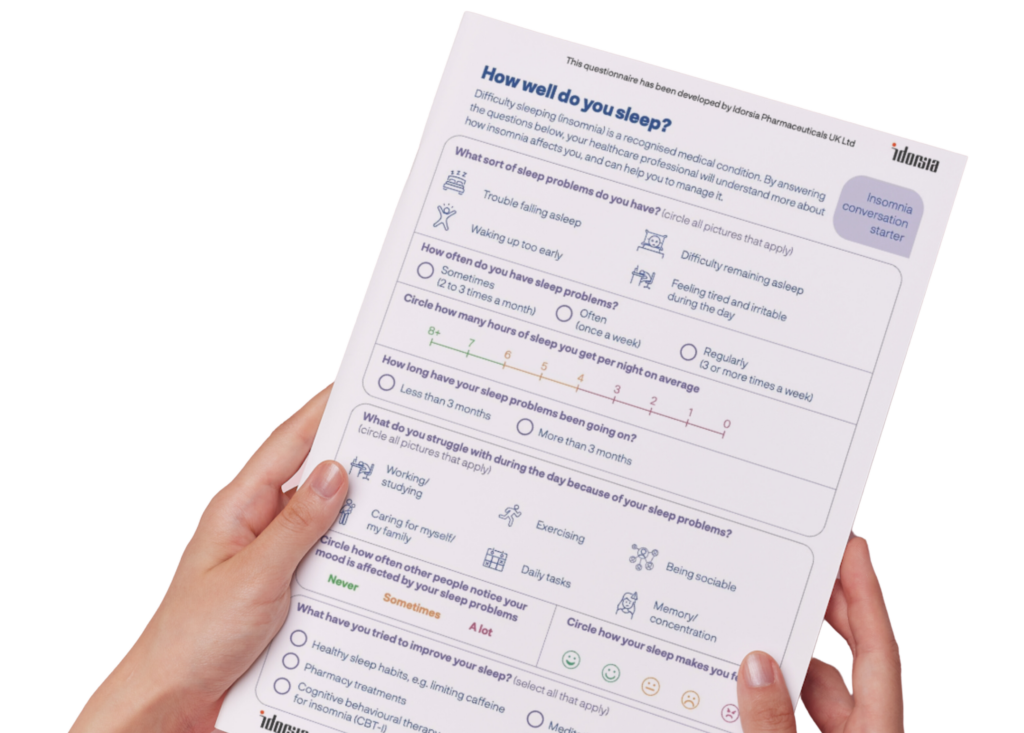
Non-pharmacological treatment


Non-pharmacological treatment
Sleep hygiene
Steve is put on a waiting list for a face‑to‑face CBTi program. In the meantime, his clinician recommends a digital CBTi course which includes sleep hygiene advice.6
Sleep hygiene for older adults is similar to younger adults, and includes:1,3,11
- maintaining a regular sleep schedule
- exercising more than 4-6 hours before bed
- avoiding going to bed hungry or thirsty (having a light snack before bed)
- avoiding excessive or late naps
- limiting caffeine later in the day and avoiding alcohol before bed
- trying to reduce mental stress/ practising relaxation before bed
Steve often falls asleep in his armchair in the late afternoon/ early evening, and then ends up going to bed late – so limiting naps and having a strict bedtime may be important steps for him. Trying to avoid smoking in the evening may also be beneficial for him.3,11
Sleep apnoea results
Results from Steve’s sleep study show that his apnoea‑hypopnea index is 6 events per hour, indicating mild sleep apnoea.
Steve is referred to a smoking cessation program and given weight loss advice. If the sleep apnoea persists, he should be offered CPAP therapy.12
Apnoea‑hypopnea index12
- 5 to 14 events per hour: mild
- 15 to 30 events per hour: medium
- >30 events per hour: severe

Steve is having difficulty engaging with the digital CBTi course due to lack of familiarity with the technology and no external support. He managed to access two of the six sessions but then gave up. The waiting list for a face-to-face course is at least 6 months.
Upon discussion with his clinician, Steve explains that he has been working on some of the recommended sleep hygiene behaviours, including limiting naps and keeping to a bedtime schedule – although says he sometimes slips back into his old habits. Steve’s insomnia persists, and he reports struggling with sleepiness and lack of concentration in the daytime.
Where CBTi is not effective or available, short-term pharmacological management can be considered.6,8
Steve has previously taken a course of melatonin, which he accessed through an online doctor.
Quiz Summary
0 of 1 Questions completed
Questions:
Information
You have already completed the quiz before. Hence you can not start it again.
Quiz is loading…
You must sign in or sign up to start the quiz.
You must first complete the following:
Results
Results
Time has elapsed
Categories
- Not categorized 0%
- Review
- Answered
- Correct
- Incorrect
-
Question 1 of 1
1. Question
CorrectIncorrect
ACE: angiotensin-converting enzyme; CBTi: cognitive behavioural therapy for insomnia; CKD: chronic kidney disease; CPAP: continuous positive airway pressure; OTC: over‑the‑counter; SGLT2i: sodium glucose cotransporter‑2 inhibitor; TIA: transient ischaemic attack
QUVIVIQ™ is indicated for the treatment of adult patients with insomnia characterised by symptoms present for at least 3 months and considerable impact on daytime functioning.18
This information is intended for UK healthcare professionals.
Adverse events must be reported. Healthcare professionals are asked to report any suspected adverse reactions via www.mhra.gov.uk/yellowcard or search for MHRA Yellow Card in Google Play or Apple App Store. Adverse events should also be reported to ds.safety.uk@idorsia.com
References
- Sleep Foundation. Aging and sleep, 19 September 2023. Available at: sleepfoundation.org. Accessed August 2025
- National Institutes of Health (NIH): National Institute on Aging. A good night’s sleep. Available at: nia.nih.gov. Accessed August 2025
- Patel D, Steinberg J, Patel P. Insomnia in the elderly: a review. J Clin Sleep Med 2018;14(6):1017-1024
- Cohen Z L, Eigenberger P M et al. Insomnia and other sleep disorders in older adults. Psychiatr Clin North Am 2022;45(4):717-734
- Duffy J F, Scheuermaier K, Loughlin K R. Age-related sleep disruption and reduction in the circadian rhythm of urine output: contribution to nocturia? Curr Aging Sci 2016;9(1):34-43
- Riemann D, Espie C A et al. The European Insomnia Guideline: an update on the diagnosis and treatment of insomnia 2023. J Sleep Res 2023;32(6):e14035
- Wilson S, Anderson K et al. British Association for Psychopharmacology consensus statement on evidence-based treatment of insomnia, parasomnias and circadian rhythm disorders: an update. J Psychopharmacol 2019;33(8):923-947
- National Institute for Health and Care Excellence (NICE). Clinical knowledge summary. Insomnia. Scenario: managing long-term insomnia (more than 3 months duration), May 2025. Available at: cks.nice.org.uk. Accessed August 2025
- National Institute for Health and Care Excellence (NICE). Clinical knowledge summary. Stroke and TIA. Scenario: secondary prevention following stroke and TIA, October 2023. Available at: cks.nice.org.uk. Accessed August 2025
- Morin C M, Belleville G et al. The Insomnia Severity Index: psychometric indicators to detect insomnia cases and evaluate treatment response. Sleep 2011;34(5):601-608
- Solikhah F K, Nursalam N, Ulfiana E. The effect of sleep hygiene on the sleep quality in elderly. Proceedings of the 8th International Nursing Conference on Education, Practice and Research Development in Nursing (INC 2017) 2017;doi: 10.2991/inc-17.2017.26
- National Institute for Health and Care Excellence (NICE). Clinical knowledge summary. Obstructive sleep apnoea syndrome. Scenario: management of sleep apnoea, May 2025. Available at: cks.nice.org.uk. Accessed August 2025
- Prolonged-release melatonin Summary of Product Characteristics
- National Institute for Health and Care Excellence (NICE). Clinical knowledge summary. Insomnia. Scenario: managing short-term insomnia (less than 3 months duration), May 2025. Available at: cks.nice.org.uk. Accessed August 2025
- Zolpidem Summary of Product Characteristics
- Zopiclone Summary of Product Characteristics
- National Institute for Health and Care Excellence (NICE). Clinical knowledge summary. Insomnia. Prescribing information: Z-drugs, May 2025. Available at: cks.nice.org.uk. Accessed August 2025
- QUVIVIQ™ Idorsia Pharmaceuticals Ltd, Summary of Product Characteristics
© NICE 2023 Daridorexant for treating long-term insomnia. Available from www.nice.org.uk/guidance/ta922. All rights reserved. Subject to Notice of rights.
NICE guidance is prepared for the National Health Service in England. All NICE guidance is subject to regular review and may be updated or withdrawn. NICE accepts no responsibility for the use of its content in this product/ publication.
UK-DA-00657 | Date of preparation: September 2025