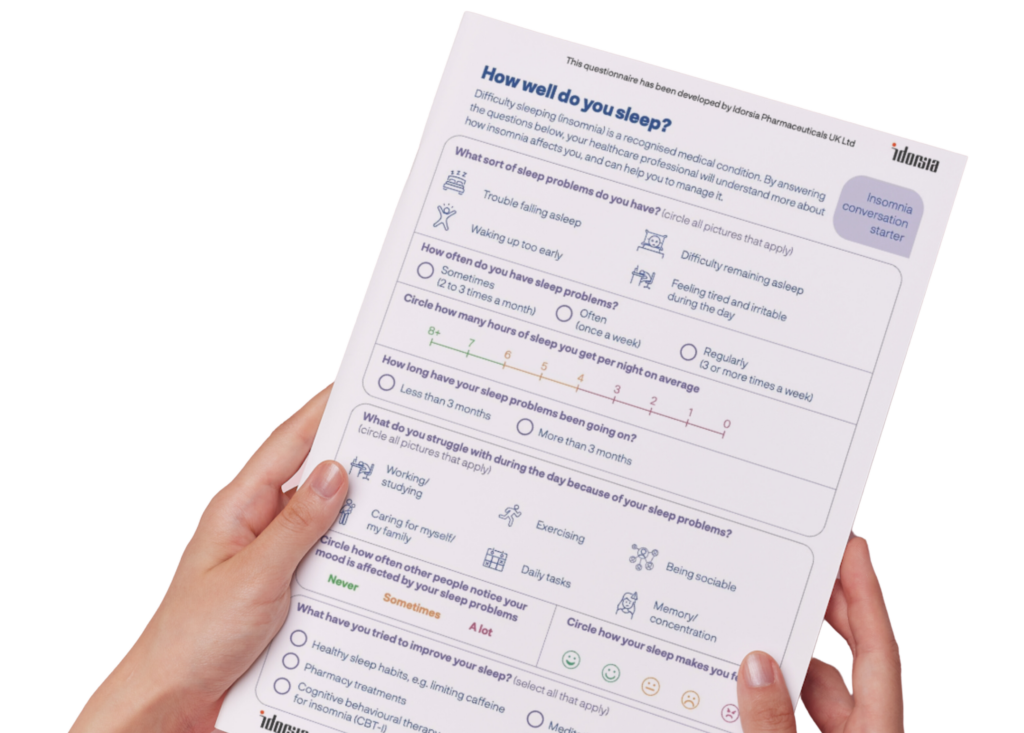
Insomnia Uncovered
6:25
8:50
3:24
8:15

8:04
10:49
More episodes in the Insomnia Uncovered series coming soon!
About this episode – What is insomnia?
In this first episode of the “Insomnia Uncovered” vodcast series, Dr Allie Hare, a consultant in sleep medicine, and Dr Cameron Livingston, a GP and sleep specialist, introduce insomnia as a 24-hour sleep-wake disorder that impacts both night-time rest and daytime functioning. They explore the differences between acute and chronic insomnia, provide an overview of the “3P” behavioural model of insomnia (predisposition, precipitation, perpetuation), and discuss the importance of understanding the broader implications of insomnia on patients’ lives. The episode also offers practical advice for primary care professionals on identifying cases requiring secondary care referral.
Key points to take away from the episode:
- Insomnia as a 24-hour disorder: Insomnia is not just a sleep issue; it has wide-ranging effects on patients’ daily lives, including increased mood disorders, and daytime fatigue.2,4
- The 3P Model of Insomnia: A framework that explains how insomnia develops and persists through predisposition, precipitating events, and perpetuating factors like maladaptive behaviours.
- Acute vs Chronic Insomnia: Acute insomnia often relates to short-term stress, while chronic insomnia involves persistent sleep disturbances and behavioural or cognitive issues.
- Daytime impairment as a diagnostic focus: Insomnia’s clinical definition emphasises its impact on daytime functioning, which varies from fatigue to mood disorders.2,4
- When to refer to secondary care: Patients with co-morbid conditions (e.g., sleep apnoea or circadian rhythm disorders) or those unresponsive to primary interventions should be referred.
About the vodcast:
The “Insomnia Uncovered” series, developed by Idorsia Pharmaceuticals UK Ltd with the support of specialists in sleep disorders, provides expert insights into insomnia diagnosis, treatment, and management. Designed for UK healthcare professionals, it offers practical tools and frameworks to improve patient outcomes in sleep medicine.
Chapters
- Introduction: 00:00
- Insomnia as a 24-hour disorder: 00:17
- Acute vs Chronic Insomnia: 01:01
- The 3P Model of Insomnia: 02:27
- Daytime impairment and its significance: 04:21
- When to refer to secondary care: 05:15
- Closing remarks and next episode preview: 06:09
If you want to see the chapters directly on the video, click on the icon in the video player:

About this episode – Insomnia diagnosis
In this episode of the “Insomnia Uncovered” vodcast series, Dr Allie Hare, a consultant in sleep medicine, and Dr Cameron Livingston, a GP and sleep specialist, discuss practical approaches to diagnosing insomnia. They explore the challenges of diagnosing insomnia in primary and secondary care settings, emphasise the importance of sleep history, and provide insights into distinguishing insomnia from other sleep disorders. Practical tools like sleep diaries and questionnaires are essential for healthcare professionals.
Key points to take away from the episode:
- Importance of sleep history: Understanding patients’ bedtime routines, sleep environments, and any factors impacting their sleep quality is critical.
- Mental and physical health connections: Insomnia often coexists with or exacerbates other conditions like depression, anxiety, and cardiovascular disease.
- Role of sleep diaries and questionnaires: Tools like the Insomnia Severity Index and the American Academy of Sleep Medicine Sleep Diary are valuable for assessing sleep patterns and identifying underlying issues.
- Recognising mimics of insomnia: Conditions such as sleep apnoea, restless legs syndrome, and circadian rhythm disorders may present as insomnia but require different treatments.
- Partner input: Partner observations can provide critical insights into patients’ nighttime symptoms, such as snoring or choking during sleep.
About the vodcast:
The “Insomnia Uncovered” series, developed by Idorsia Pharmaceuticals UK Ltd with the support of specialists in sleep disorders, delivers expert insights into insomnia’s diagnosis, treatment, and management. Designed for UK healthcare professionals, it provides practical tools to improve patient outcomes in sleep medicine.
Chapters
- Introduction and vodcast overview: 00:00
- Mental and physical health links to insomnia: 01:15
- Challenges of diagnosing insomnia in primary care: 02:07
- Sleep history and sleep hygiene assessment: 03:50
- Sleep diaries and questionnaires: 05:34
- Distinguishing insomnia from other sleep disorders: 06:15
- The role of partner input in diagnosis: 07:16
- Conclusion and key takeaways: 08:20
If you want to see the chapters directly on the video, click on the icon in the video player:
About this episode – Living with insomnia
In this episode of the “Insomnia Uncovered” vodcast series, Dr Allie Hare, a consultant in sleep medicine, and Dr Cameron Livingston, a GP and sleep specialist, discuss the wide-ranging impact of insomnia on individuals and society. They highlight the societal cost of insomnia, its effect on workplace performance, and the need for improved identification and treatment. Drawing on insights from the RAND report, the episode underscores the urgency of addressing insomnia’s broader implications.
Key points to take away from the episode:
- Impact on daytime functioning: Insomnia symptoms significantly affect workplace performance, contributing to absenteeism, reduced productivity, and even job loss.5
- Societal cost of insomnia: Beyond individuals, insomnia impacts families, employers, and the economy at large, with financial and productivity losses noted in the RAND report.5
- Prevalence of insomnia: 50% of working adults experience insomnia symptoms, with 25% meeting clinical criteria and 15% suffering from chronic insomnia.
- Economic implications: Treating insomnia symptoms more effectively could increase GDP by 1.3%, demonstrating its significant economic importance.5
- Raising awareness among clinicians: Healthcare professionals should prioritise identifying and addressing insomnia to improve both individual and societal outcomes.
About the vodcast:
The “Insomnia Uncovered” series, developed by Idorsia Pharmaceuticals UK Ltd with the support of specialists in sleep disorders, delivers expert insights into insomnia’s diagnosis, treatment, and management. Designed for UK healthcare professionals, it provides practical tools to improve patient outcomes in sleep medicine.
Chapters
- Introduction and vodcast overview: 00:00
- Insomnia’s impact on workplace performance: 01:01
- Broader effects of insomnia on families and society: 01:34
- Insights from the RAND report on insomnia: 02:07
- Prevalence of insomnia in working adults: 02:24
- Economic benefits of addressing insomnia: 02:54
- Conclusion and key takeaways: 03:08
If you want to see the chapters directly on the video, click on the icon in the video player:
About this episode – Cognitive behavioural therapy for Insomnia (CBTi)
In this episode of the “Insomnia Uncovered” vodcast series, Dr Allie Hare, a sleep medicine consultant, and Dr Cameron Livingston, a GP and sleep specialist, explore cognitive behavioural therapy for insomnia (CBTi) as the first-line treatment for chronic insomnia. They discuss challenges in accessing CBTi, its core components, and how to engage patients in treatment. The episode emphasises the importance of proper framing, setting expectations, and addressing patient resistance for successful outcomes.
Key points to take away from the episode:
- CBTi as the gold standard: CBTi is the recommended first-line treatment for chronic insomnia, showing sustained improvements of sleep parameters including sleep quality.6
- Challenges in access: Access to CBTi has historically been variable, with many patients relying on digital versions like Sleepio.7
- Core components of CBTi:
- Sleep restriction (or rescheduling): Reducing time spent in bed to increase sleep drive and consolidate sleep.
- Stimulus control: Rebuilding the bed-sleep connection by avoiding wakeful activities in bed.
- Cognitive strategies: Techniques like cognitive distraction and progressive muscle relaxation to reduce cognitive arousal and quiet the busy mind.
- Importance of patient education: Explaining the rationale and effectiveness of CBTi helps patients overcome resistance, especially when treatments seem counterintuitive.
- Effectiveness of CBTi: 70-80% of patients completing CBTi experience improved sleep, and 50% achieve clinically meaningful outcomes.6
About the vodcast:
The “Insomnia Uncovered” series, developed by Idorsia Pharmaceuticals UK Ltd with the support of specialists in sleep disorders, provides expert insights into insomnia diagnosis, treatment, and management. Designed for UK healthcare professionals, it offers practical tools to improve patient outcomes in sleep medicine.
Chapters
- Introduction and vodcast overview: 00:00
- CBTi as the first-line treatment for chronic insomnia: 00:17
- Challenges in accessing CBTi and its variability: 01:13
- Explaining CBTi to patients and addressing resistance: 02:12
- Sleep restriction and stimulus control therapy: 05:21
- Cognitive strategies to quiet a busy mind: 07:05
- Conclusion and key takeaways: 07:56
If you want to see the chapters directly on the video, click on the icon in the video player:
About this episode – Pharmacological treatment options
In this episode of the “Insomnia Uncovered” vodcast series, Dr Allie Hare, a consultant in sleep medicine, and Dr Cameron Livingston, a GP and sleep specialist, discuss pharmacological treatment options for insomnia. They emphasise the challenges and opportunities of using medication alongside cognitive behavioural therapy for insomnia (CBTi). They explore the limitations of traditional sleep medications, the concerns surrounding their side effects, and the emergence of treatment options like QUVIVIQ™▼ (daridorexant), offering a novel mechanism of action.
Key points to take away from the episode:
- CBTi as first-line therapy: Cognitive behavioural therapy remains the recommended first-line treatment for chronic insomnia but is not always accessible or appropriate for all patients.8
- Challenges with traditional medications:
- Medications like zolpidem, zopiclone, and melatonin are often used but have limitations such as dependence risks, and morning grogginess.2
- Concerns include side effects like falls in older patients, memory and cognition issues, and difficulties maintaining sleep.9,10
- A different pharmacological option for chronic insomnia:
- QUVIVIQ™▼ (daridorexant) is a dual orexin receptor antagonist approved by NICE for chronic insomnia.3
- Unlike other sleep medications, it targets wakefulness systems, addressing both sleep initiation and maintenance, with clinical trial data showing improvements in total sleep time and daytime functioning.2,4
- Patient engagement and shared decision-making:
- Educating patients on treatment options, including the novel mechanism of action of daridorexant, can empower them to make informed decisions.
- Highlighting improvements in daytime functioning and socio-economic impacts of insomnia helps set meaningful treatment goals.
About the vodcast:
The “Insomnia Uncovered” series, developed by Idorsia Pharmaceuticals UK Ltd with the support of specialists in sleep disorders, provides expert insights into insomnia diagnosis, treatment, and management. Designed for UK healthcare professionals, it offers practical tools to improve patient outcomes in sleep medicine.
Chapters
- Introduction and vodcast overview: 00:00
- CBTi and its limitations in accessibility: 00:55
- Concerns with traditional insomnia medications: 02:16
- Introduction to daridorexant and its mechanism of action: 05:21
- Clinical trial data and benefits of daridorexant: 06:23
- Importance of shared decision-making with patients: 07:05
- Daytime functioning as a key treatment target: 07:23
If you want to see the chapters directly on the video, click on the icon in the video player:
About this episode – Ongoing management of insomnia
In this episode of the “Insomnia Uncovered” vodcast series, Dr Allie Hare, a consultant in sleep medicine, and Dr Cameron Livingston, a GP and sleep specialist, discuss the ongoing management of insomnia. They focus on the challenges of managing patients already using long-term medications, the importance of shared decision-making, and integrating pharmacological and non-pharmacological approaches, including good sleep hygiene practices.
Key points to take away from the episode:
- Challenges with existing long-term medication use:
- Many patients use antihistamines or over-the-counter medications that may no longer be effective or appropriate.
- Conversations about stopping such medications can be difficult, but discussing shared goals and alternatives is crucial.
- CBTi as a foundational approach:
- Analogies, like removing a plaster to treat the underlying wound, can help patients understand why CBTi is critical, even if it feels uncomfortable at first.
- Pharmacological options for chronic insomnia:
- QUVIVIQ™▼ (daridorexant) offers a long-term treatment option, with no evidence of dependence or rebound insomnia upon discontinuation of QUVIVIQ™ in clinical trials, with up to 12 months of nightly use.1
- Patient expectations about treatment timescales with QUVIVIQ™ need to be managed, because its mechanism of action differs from other hypnotics.
- Holistic and individualised care:
- Management plans should incorporate sleep hygiene, behavioural components of CBTi, and pharmacological treatments when necessary.
- Addressing comorbid conditions and considering the sleep environment is essential for a holistic approach.
- Shared decision-making:
- Collaborative discussions with patients to establish shared goals and treatment outcomes are key to effective ongoing management.
About the vodcast:
The “Insomnia Uncovered” series, developed by Idorsia Pharmaceuticals UK Ltd with the support of specialists in sleep disorders, provides expert insights into insomnia diagnosis, treatment, and management. Designed for UK healthcare professionals, it offers practical tools to improve patient outcomes in sleep medicine.
Chapters
- Introduction and vodcast overview: 00:00
- Challenges of managing patients on long-term sedating medications: 01:22
- Importance of addressing the root cause of insomnia with CBTi: 03:06
- Introducing daridorexant as a long-term treatment option: 05:28
- Setting patient expectations for daridorexant: 06:06
- Integrating behavioural and pharmacological approaches: 08:30
- Holistic and individualised management plans: 09:16
- Conclusion and key takeaways: 10:12
If you want to see the chapters directly on the video, click on the icon in the video player: